


Wireless Handheld Pocket Ultrasound vs. Traditional Cart-Based Ultrasound: What Are the Differences
- 2026-07-21
- 1658
- Guangzhou Sonostar Technologies Co., Limited
This question troubles many department heads responsible for equipment selection, especially in primary care settings. As a representative of emerging technology, SonoStar wireless ultrasound—through wireless transmission and portable design—aims to achieve more efficient and accurate diagnostic workflows, revolutionizing clinical examination models. This article breaks down the core differences between the two device types from four dimensions: structural form, usage scenarios, image performance, and cost investment, offering practical reference for departmental procurement.
Structural Form: From "Host + Probe" to "Probe as the Host"
Traditional cart-based ultrasound systems consist of a standalone host unit and a wired probe. The host is bulky and requires trolley transport, while the probe connects to the host via a cable, making wiring cumbersome. This design dictates that the system must be deployed in a fixed location, such as a dedicated ultrasound examination room.
Take SonoStar's wireless handheld pocket ultrasound as an example: it condenses all computing power, battery, and Wi-Fi module into the probe itself. It fits in one hand, weighs about 300 grams, roughly the size of a smartphone. Simply install an app on a mobile phone or tablet to display images and operate the device. In essence, it eliminates the bulky host and the cumbersome cable.
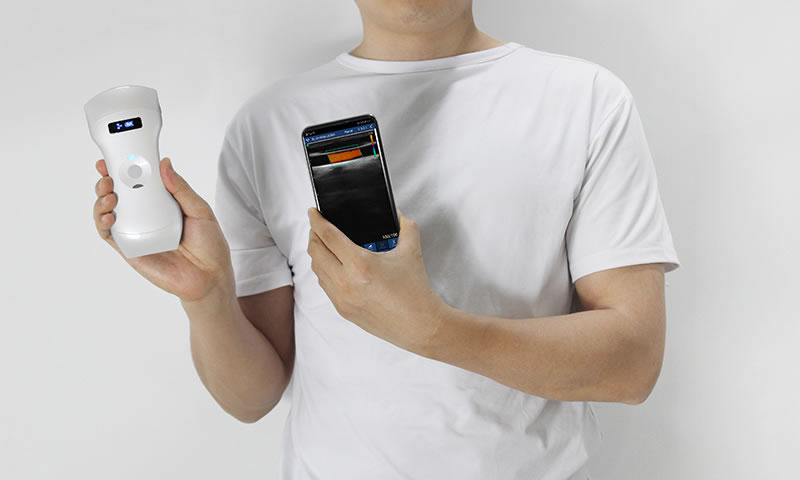
Usage Scenarios: Fixed Examination Room vs. On-the-Go Flexibility
Traditional ultrasound is suitable for in-depth examinations in the ultrasound room, where patients must go to a designated location and wait in line. For scenarios requiring immediate diagnosis—such as emergency departments, ICUs, ambulances, and bedside examinations in wards—traditional equipment falls short: it cannot be easily moved, cables cannot be connected, or space does not permit.
Wireless handheld ultrasound, on the other hand, is all about "examine anywhere you go." At emergency sites, beside hospital beds, in outdoor first aid, or during outreach visits to primary care facilities, you just take out the probe, connect it to your phone, and start scanning. For interventional punctures, PICC line placement, or anesthesia guidance, slipping on a disposable cover solves disinfection issues, avoiding the repeated cleaning required for traditional probes. Some brands, like SonoStar, offer a practical feature: captured images can be sent directly via WeChat to senior physicians for consultation, making teleconsultation very convenient.
Image Performance: Complementary Strengths, Not Replacement
This is a major concern for many. Objectively speaking, in terms of penetration depth and image detail, wireless handheld ultrasound still lags behind large-scale systems. High-end cart-based ultrasound features premium probes and powerful algorithms, delivering clearer images of deep tissue structures, along with various advanced measurement and analysis functions.
Wireless handheld ultrasound, however, offers image quality comparable to portable cart-based systems and is fully capable for rapid screening and preliminary examinations. It excels in assessing superficial tissues, vascular localization, fluid detection, and preliminary fracture screening. Complex deep-tissue diagnosis, detailed fetal anomaly scanning, and fine evaluation of cardiac structures still require large-scale equipment.
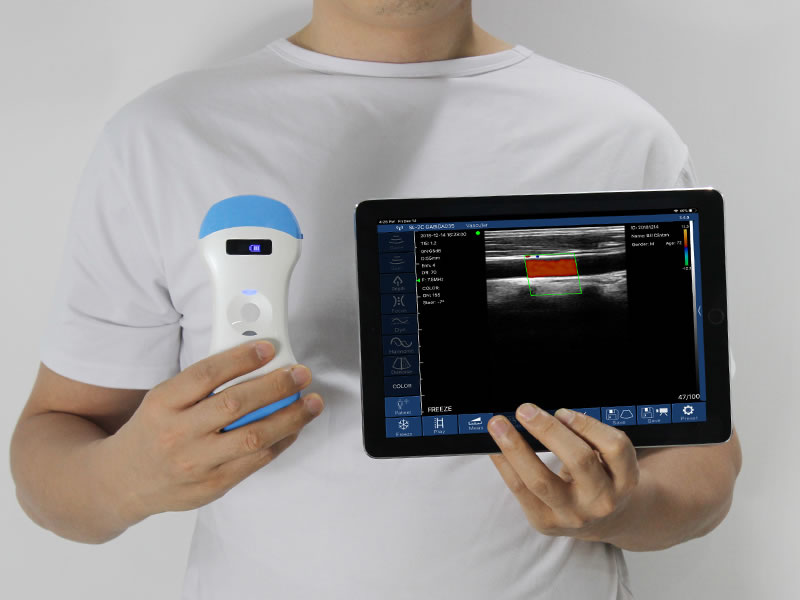
So, to be precise, wireless handheld ultrasound serves as a powerful complement to traditional cart-based systems, not a replacement. Equipping a clinical department with a wireless device for emergency and preliminary screening, and then referring uncertain cases to the ultrasound room for in-depth examination, improves overall efficiency.
Cost Investment: Differences in Purchase Price and Operating Expenses
Traditional imported ultrasound systems often cost hundreds of thousands or even over a million yuan; even domestic major brands start at around 100,000 yuan or more. Moreover, one unit can only be used in one place, and budget pressures make it difficult for departments to purchase multiple units.
Wireless handheld ultrasound costs just a fraction of imported systems—only a few percent of the price. Departments can equip several units, or even issue one to each staff member, without significant financial strain. Operating costs are also low: no dedicated space, no trolley, no dedicated maintenance staff. For primary care facilities, this cost-performance ratio is very attractive.

Frequently Asked Questions
Q: Is the image quality of wireless handheld ultrasound really sufficient?
A: For emergency checks, preliminary screening, and visual guidance, it is more than adequate. However, for complex cases requiring in-depth diagnosis, we recommend referring patients to the ultrasound room for evaluation with large-scale equipment.
Q: How is disinfection handled?
A: During interventional and surgical guidance, simply cover the probe with a disposable protective sheath to prevent cross‑infection—this is more convenient than repeated cleaning of traditional probes.

Q: How long does battery life last?
A: The built‑in battery supports routine daily examinations. Specific duration depends on usage frequency; generally, it can run continuously for several hours.
In summary: Traditional systems prioritize depth, functionality, and fine‑detail examinations in fixed settings; wireless handheld devices prioritize flexibility, convenience, and rapid screening at the point of care. The two are complementary. When selecting equipment, the key is to clarify the primary needs of your department. If you have further questions about wireless ultrasound equipment selection, please contact us at: 400-019-8196. We will provide professional equipment configuration advice tailored to your needs.


 Home
Home Product
 News
News Contact